How to Name a Credit Union
Choose a name for the institution you’re becoming. Respect the people who already trust you.

A credit union’s name appears everywhere trust gets tested. On a debit card. In a mortgage application. In a text message a member isn’t sure is real.
It also works before that relationship exists. A prospective member hears it and decides, often with very little information, whether this institution might be for them.
That’s a lot to ask of a few words. And it’s why naming deserves more than a brainstorming session followed by a board vote on everyone’s favorite.
A strong name makes your credit union easier to remember, understand, and choose. Getting there takes a clear business reason, thoughtful creative work, legal review, and research that asks better questions than “Do you like it?”
We’ve renamed credit unions in Maine, New Hampshire and Wisconsin: Northeast Credit Union became Lighthouse, Rainbow Federal Credit Union became Dirigo, and Badger Globe Credit Union became Linden. Here’s how we’d approach it.
Make the case before making names.
A name change creates real work. Members have to learn it. Employees have to explain it. Your team has to replace signage, update systems, and reconnect years of recognition to a new word.
There should be a business problem worth that effort.
Perhaps the name still references an employer you no longer exclusively serve. Perhaps people confuse you with another institution. A merger may bring together organizations with different histories. Or your growth strategy may extend beyond the place your name describes.
Those are useful starting points. “It feels dated” needs more investigation. Sometimes the identity, messaging, or experience needs work while the name still does its job.
The first decision
Rename, refresh, or investigate?
- Eligible people assume they can’t join.
- Test whether the name creates that impression, or whether eligibility messaging is missing.
- People confuse you with another financial institution.
- Look at actual search results, misdirected inquiries, and research on recognition.
- The name describes a market you’re moving beyond.
- Evaluate it against the approved growth strategy and field of membership.
- The brand looks old, but people know and trust the name.
- Consider a new identity and clearer positioning before giving up that recognition.
- Growth has slowed.
- Investigate the offer, awareness, service, and account-opening experience. A new name can’t repair all four.
Ask current members and eligible nonmembers what the existing name tells them. Compare that with what leadership believes it communicates. The gap gives you something concrete to work with.
The decision to document
“Our current name creates this specific problem for these people. Changing it will help us pursue this business objective.”
If that sentence is still vague, keep working on the diagnosis.
Agree on the job the name has to do.
Naming gets subjective when the team hasn’t agreed on what a good answer looks like. One person wants local roots. Another wants national reach. Someone else wants to keep the initials. Every candidate becomes a referendum on a strategy nobody settled.
Write a brief before anyone brings a list of names. It should fit on a page and give the creative team enough direction to make meaningful choices.
Planning tool
The one-page naming brief
An illustrative starting point. Make every answer specific to your credit union.
- Business goal
- Build recognition among eligible households beyond our original employer group.
- Audience
- Current members and people in our approved service area who don’t realize they can join.
- Promise
- Practical guidance that helps members make confident financial decisions.
- Character
- Capable, approachable, and steady. Comfortable discussing a first account or a complex loan.
- Must work
- In conversation, on a phone screen, in a branch, and alongside the required legal name.
- Must avoid
- Employer exclusivity, a misleading geographic limit, and similarity to nearby financial brands.
- Evidence
- Member and prospect research, competitive review, and the credit union’s actual growth plan.
Be equally clear about what stays. A founding story, a service commitment, or a relationship with a community may matter deeply even if the old name doesn’t survive. Identify how those things will remain visible.
For a merger, decide the brand structure early: one shared name, or a legacy name kept for a while. A combined name can work as a transition, but it shouldn’t become permanent just because it’s easier to negotiate. Decide who recommends, who advises and who approves, and confirm any required votes under your governing documents.
From our work
From Badger Globe to Linden Credit Union
Name for the members you want next.
Badger Globe’s name reflected its beginnings at a Wisconsin paper mill. By the time membership expanded to seven counties, the credit union needed to reach younger families, rural towns and a growing Hispanic community. The old name still left some people wondering whether they could join.
Our brief called for a name that felt more modern, inclusive and visible without losing the warmth members already valued. It also had to work in English and Spanish from the first round.
Linden takes its name from the linden tree: deeply rooted, a place to gather and always growing. That idea became the brand promise, Room to Grow. We built the name, identity, website and launch around it.
Explore different ideas. Then find the words.
Start with several creative directions: belonging, guidance, local character, shared progress, or another idea supported by the strategy. Explore different ways to express each one. Otherwise, a hundred names can turn out to be a hundred versions of the same thought. We usually generate 100+, then screen them down to the 30 to 40 our client sees in the first round. By the time a name reaches the board, it’s one of a handful of finalists.
- 200 to 500names generated
- 30 to 40shown to the client in round one
- A handfulof finalists for the board
- 1chosen
There isn’t one correct type of credit union name. Each approach gives you something and asks something in return.
Descriptive. Signals a place, group, or service directly, like Northeast or Virginia Credit Union. It can offer immediate clarity, but may become restrictive as membership or geography changes.
Rooted in place. Draws on local language, history, or landscape, like Dirigo, Maine’s state motto. It can create real meaning for a community. Test whether that meaning travels to the audiences you want to reach.
Evocative. Suggests a benefit or a role in people’s lives, like Lighthouse or Linden. It gives the brand an idea to develop, but familiar symbols and words can be crowded territory.
Invented. Creates a new word or an unfamiliar combination, like Ellafi or Multipli. It may give you more room to distinguish the brand, while demanding more effort to establish pronunciation, meaning, and trust.
Give each candidate a fair hearing.
Show the name in plain type first, with the same level of explanation for every option. A beautiful logo can make a weak name look more convincing than it is.
Then try ordinary situations. Answer the phone with it. Read it in a sentence about a mortgage. Picture it in an app listing. Ask someone to spell it after hearing it once. Look at the acronym people will inevitably create.
From our work
From Northeast to Lighthouse Credit Union

A name with a clear idea behind it can shape the whole brand.
Northeast described a region. Lighthouse expressed the credit union’s role in helping members find their way. We tested the finalists with people in New Hampshire, Maine and across the country, first as plain words and then inside a full identity. Lighthouse outperformed Northeast on every trait we measured, from friendly and trustworthy to distinctive and unique.
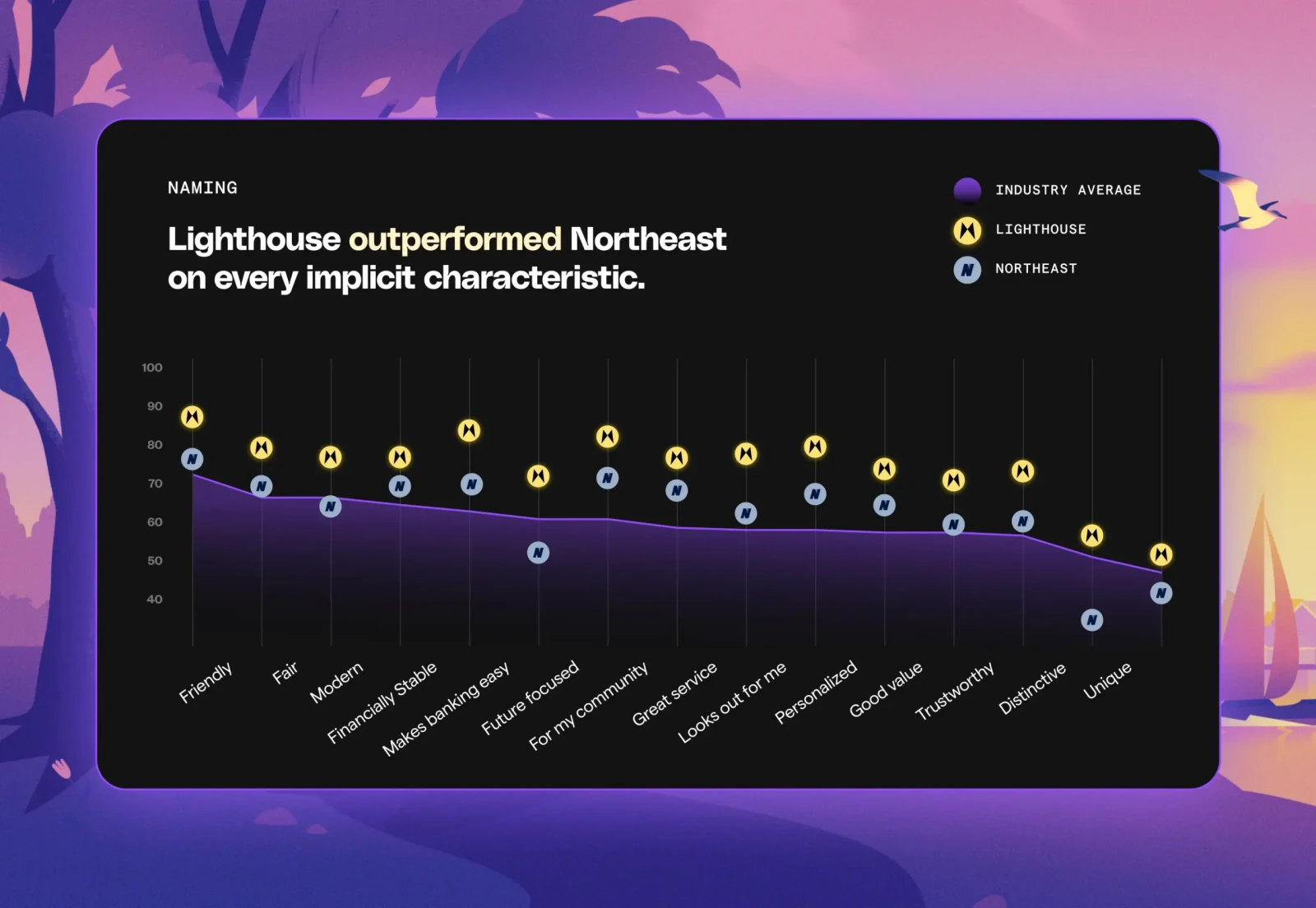
The idea then shaped the identity, illustrations, website and campaigns. Within two years of our first research call, brand awareness rose 40%, membership grew 123% faster than the industry average and home equity loans rose 50%. The website earned the first Webby Award ever won by a credit union.
Find the problems before the favorite.
Screen names as you develop them. It’s expensive to discover a serious conflict after the board has fallen in love with an option.
Every name we develop has to pass the phone test, the search test and the “I bank at ___” test before it goes further. Finalists then get a full review with trademark counsel and your regulator. Keep these three questions separate.
Can we use and protect it?
Review existing financial brands, similar spellings and sounds, and federal trademark records in Class 36, which covers financial services. The USPTO’s clearance guidance explains why a search has to go beyond exact matches. Your trademark attorney makes the final call.
Can it be our approved name?
A federal credit union’s official charter name must end in “Federal Credit Union,” and NCUA screens out names that are confusing or misleading under its name-selection guidance. You can market under a trade name without those words, as NCUA explains in its separate guidance on trade names. State-chartered credit unions go through their state regulator.
Can people find us without confusion?
Inspect search results, domains, app stores, map listings, and social handles. Look for similar financial businesses as well as awkward abbreviations and misspellings. An available domain doesn’t establish trademark rights or regulatory approval. And a desirable domain shouldn’t rescue a strategically weak name.
Review pronunciation and meaning in the languages relevant to your members. Include fluent speakers who understand cultural context. A translation tool won’t reliably catch an unfortunate association or a phrase that sounds strange in ordinary conversation.
Keep more than one finalist moving through review. Lock down domains and social handles the day the board picks the name, before word gets out.
A distinction worth protecting
A broader name doesn’t itself expand who can join. The name, charter, and field of membership need to support the same business plan.
Test what people understand and remember.
“Which name do you like best?” can start a conversation. It shouldn’t settle the decision.
People bring associations you couldn’t have predicted. Some are valuable warnings. Some are personal preferences. Research should help you tell the difference and understand how the name performs without a ten-minute explanation.
Include current members and eligible prospective members. Examine their responses separately: someone with decades of attachment to the existing name has a different starting point from someone who’s never heard of you. Include the regions and languages that matter to the growth plan.
Five questions worth answering
- Clarity “What kind of organization would you expect this to be?” Test the complete name, including its credit union descriptor.
- Association “What comes to mind?” Ask before explaining the strategy.
- Ease Ask people to say it, then spell it after hearing it.
- Memory After an unrelated task, ask which names they remember without showing the list again.
- Relevance “Who does this seem to be for?” Then explore whether they can see themselves joining.
Use consistent presentation, rotate the order, and give each candidate comparable exposure. Test the name on its own before showing equivalent applications. Otherwise, you may be measuring a stronger design or a more persuasive story.
Include the current name as a reference, while accounting for its familiarity. A new option shouldn’t be expected to have decades of recognition on day one.
A few patterns show up again and again in our testing. Names that signal speed can unsettle people who worry about risk. Pairing a strong word with “First” can make it sound religious. And names people can picture get stronger once there’s design around them.
From our work
From Rainbow to Dirigo Federal Credit Union


Rainbow Federal Credit Union became Dirigo Federal Credit Union.
Dirigo is Maine’s state motto, meaning “I lead.” It gave the credit union a name connected to its home and an idea to build around. Our work extended from naming into identity, messaging, the website, and marketing.
In four years, assets grew 48%, organic search traffic grew 203% and monthly online membership applications grew 3.5 times. Dirigo now manages nearly $500 million in assets under the name we gave it.
Make a decision you can explain.
By this point, the team should be discussing a small set of credible candidates. Each should have a strategic rationale, documented screening, research findings, and an honest account of its weaknesses.
Compare them against the brief you approved at the beginning. Don’t quietly replace the criteria because a senior person prefers another option.
A starting point for your team
The naming scorecard.
| What to evaluate | Weight |
|---|---|
| Strategic fitDoes it support our audience, promise, and direction? | 25% |
| DistinctivenessCan people distinguish it from the alternatives? | 25% |
| Ease of useCan people say, spell, remember, and find it? | 20% |
| MeaningDoes it create useful associations we can support? | 15% |
| Room to growWill it work as our membership and offer evolve? | 15% |
| Total weight | 100% |
These are the weights we start with. Agree on your own before anyone sees a name. Score each criterion from 1 to 5, multiply by its weight, and compare the weighted totals out of 5. Keep legal and regulatory requirements as separate gates; a high average can’t cancel a serious conflict.
Have decision-makers score on their own before the group meets, so the loudest voice in the room doesn’t pick the name. Ask each person to explain the evidence behind their score.
Put the full cost in front of the board.
Naming fees are only part of the investment. Budget for research, counsel, domains, identity, signage, cards and printed materials, digital updates, vendor changes, staff training, and member communications. Assign owners and include a contingency.
Timing can save you money. Line up the name change with work you’re already planning, like a new website or a charter change, and one launch does the job of two.
Keep the business case honest. The expected benefit may be removing a barrier to consideration or making future growth easier. Don’t turn that into an unsupported revenue forecast.
The final recommendation should explain why the selected name is right, what was ruled out, what risks remain, and what must happen before launch. A documented decision is easier to defend and easier for the team to deliver.
Make the change easy to understand.
Leadership may have spent a year with the new name. Most members will meet it in a single email, a branch visit, or a notice on their phone.
Start with their questions. Why is this happening? Is my money safe? Is this a merger? Will my card work? Do I need to change anything?
Answer each one with confirmed facts. If accounts, cards, routing numbers, insurance arrangements, or access are changing, explain exactly how and when. If they aren’t, say so. Never borrow a reassuring line from another institution’s rollout without checking it against your own.
The member letter we wrote for Linden announced the change, then reassured members that their account and routing numbers, branch and familiar team would stay the same. Only then did it explain the new name.
Build the member announcement around four answers
- What’s changing, what isn’t, and what members need to do.
- Why we’re changing the name, in plain language.
- What the name means and how it connects to members.
- Where to get help and verify that a message is real.
Treat launch as an operational project.
- People: Brief employees before the public launch. Give frontline teams a short explanation, a practical FAQ, and an escalation contact.
- Channels: Don’t count on email alone. Use mail, branch screens and conversations at the counter, and leave time for mail to reach members who live out of state.
- Places: Coordinate branches, signage, ATMs, printed materials, and any transition notices.
- Platforms: Align the website, digital banking, app listings, account opening, email, and third-party providers.
- Findability: Plan redirects, old-name search coverage, business listings, and accurate updates across directories.
- Recognition: Use approved “formerly” messaging where useful. Maintain clear links between the old and new identity during the transition.
- Security: Keep control of old domains and relevant addresses. Publish verified contact routes and explain how members can recognize legitimate communications.
If multiple names remain in use, make their relationship clear. NCUA’s guidance on using more than one name specifically addresses the risk of members mistaking branches of one institution for separately insured credit unions.
Measure understanding after the announcement.
Set a baseline before launch, then review name recognition, confusion, support inquiries, old-name searches, website traffic, application completion, and retention at agreed intervals. Compare current members with prospects where the data allows.
Track business outcomes too, but account for other changes happening at the same time. A new name often arrives with a new website, campaigns, products, or a merger. Growth after launch doesn’t tell you how much the name alone caused.
Before you start.
How long does it take to rename a credit union?
Plan on most of a year from first research to launch day. The calendar usually comes down to how many naming rounds you need, how quickly your regulator and attorney move, and your vendors’ lead times.
Do members have to vote on a credit union name change?
Usually not. The board approves the new name and your regulator signs off. A charter conversion or a merger is different and can require a member vote, so confirm what applies to your charter with counsel.
Should members vote on the new name?
No. We test names with members, but we don’t put the choice to a popular vote. Testing tells you how people react. The brief and the board make the call.
Does the name have to include “Federal Credit Union”?
Your official federal charter name does. You can market under a trade name without it, but you still use the official name with government agencies and in documents that legally bind the credit union. State-chartered credit unions follow their state regulator’s rules.
Should we keep our current name as an option?
Yes. Keeping it gives the team a serious alternative to compare against the cost and risk of changing. If the problem can be solved through clearer eligibility messaging, a new identity, or a better experience, a rename may not be the right investment.
What’s the biggest naming mistake?
Choosing before agreeing on the criteria. Once people are attached to a favorite, every discussion becomes harder. Approve the brief, decision process, and evaluation approach first. Then judge names by the job they need to do.
Related perspective: What credit unions can learn from consumer brands.
Considering a new name, a merger, or a broader rebrand? We help credit unions connect the business decision to the brand, the member experience, and the work required to launch. Explore our credit union work or talk with our team.
Let’s talk.
Interested in working with us? Ready to start a project? If you’re excited, we’re excited. Drop us a line to start a conversation.
"*" indicates required fields